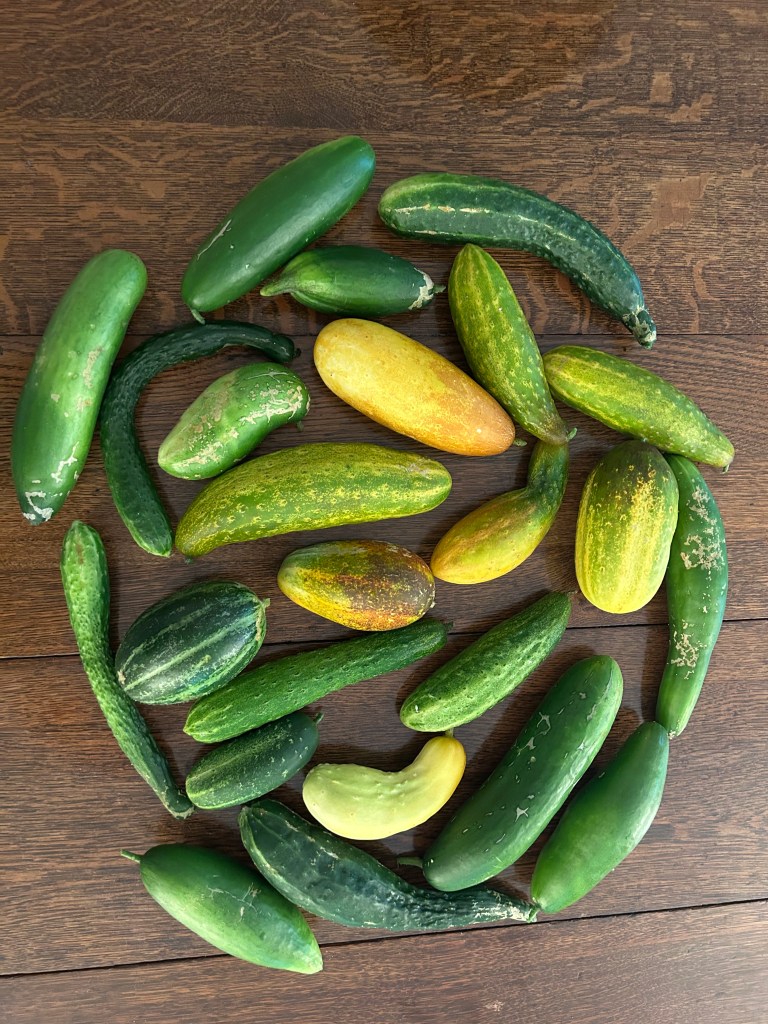
If you’ve only eaten cucumbers from a supermarket you probably think there are four kinds: “slicers,” or regular cucumbers; pickling cucumbers; “English” cucumbers; and gherkins, which come in jars. But that’s so wrong: there are at least 100 kinds, different varieties grown around the world.
We have been playing with cucumbers for a few years, relying mostly on the Cucumber Shop for sourcing and for information. (They are very helpful.) Some of our cucumbers are the “regular” or Indian type (cucumis sativus), which most people in the States are used to seeing. Others are actually from the melon family (cucumis Melo). They are very young melons, not grown to full melon maturity, that taste and act like cucumbers.
We use all of these cucumbers in all sorts of ways — we slice and eat them raw in salads and such. we make wonderful summer soups out of them. We do fast Asian-style pickles. And we pickle them as bread-and-butter pickles or garlic dill pickles or whatever. You can pickle any cucumber — you don’t need one labelled as a “pickler.” We bring selections of these cucumbers to Gilmanton’s Own Market for sale in season. (Open Thursdays 3-5:30, Saturdays 10-4. Sundays 11-3: 741 Province Rd., Gilmanton, NH.)
Here are the kinds we have in our garden this year:
- Armenian (c. melo)
- Carosello Leccese Striped (c. melo): grown in Italy
- China Jade (c. sativus): bitter-free Asian variety
- Diva (c. sativus): a pretty one. Bitter-free with tender skin, almost seedless.
- Nokya: An Asian hybrid variety
- Painted Serpent (Striped Armenian; c. melo): long tender, crisp.
- Poona Kheera (c. sativus): yellow/brown oval from India.
- Sikkim (c. sativus): Himalayan variety, yellow to brown oval, sometimes with netted cracks.
The taste of these is not massively different, but different enough to make cucumbers more interesting than perhaps they otherwise might be. We love sampling the different ones and using them together.
 Jones Mill House